

- HOME
- Newsroom
- News Releases
- YKK AP Begins Operation of "N-CueB," a Large-scale Curtain Wall Testing Building at the Namerikawa Plant
YKK AP Begins Operation of "N-CueB," a Large-scale Curtain Wall Testing Building at the Namerikawa Plant
Installation of this Facility, One of the Largest in Japan, Enables Product Testing to Meet Performance Requirements for Skyscrapers and Large Typhoons
YKK AP Inc. (Head Office: Chiyoda-ku, Tokyo; President: Akira Uozu) is working to enhance its capabilities in the performance testing of curtain walls (CWs), a commercial architectural product that is required to accommodate the increasing height of buildings and the ever-intensifying natural disasters that they face. Accordingly, it is pleased to announce that the testing facilities at the Kurobe Plant (Kurobe City, Toyama Prefecture) have been renewed for the first time in 38 years, and that a new large-scale curtain wall testing building, "N-CueB," one of the largest such facilities in Japan, has been constructed at the Namerikawa Plant (Namerikawa City, Toyama Prefecture). This latter facility will begin operations on January 8.

A CW is an exterior wall composed of glass, panels, etc. that is attached like a curtain around the structure (pillars and beams) of a high-rise building or other structure. In recent years, CWs have become larger and heavier as buildings constructed under urban redevelopment projects and similar initiatives have grown in terms of both total height and floor height(*1). In addition, to cope with record-breaking heavy rainfall and strong winds caused by climate change, as well as major earthquakes, the exterior walls of buildings are required to deliver performance in terms of wind pressure resistance, watertightness, and seismic resistance. In order to meet these performance and quality requirements for CWs, YKK AP has rebuilt the existing CW testing facilities at the Kurobe Plant as a new CW testing building, "N-CueB," at the Namerikawa Plant. The "N" stands for "Novel," "Next," and "Namerikawa," while "CueB" stands for "Curtain wall testing & evaluation Building" and represents the cube shape of the facility. As such, the name embodies YKK AP’s aspiration for N-CueB to "serve as a new evaluation site for CWs, creating the building technology of the future."

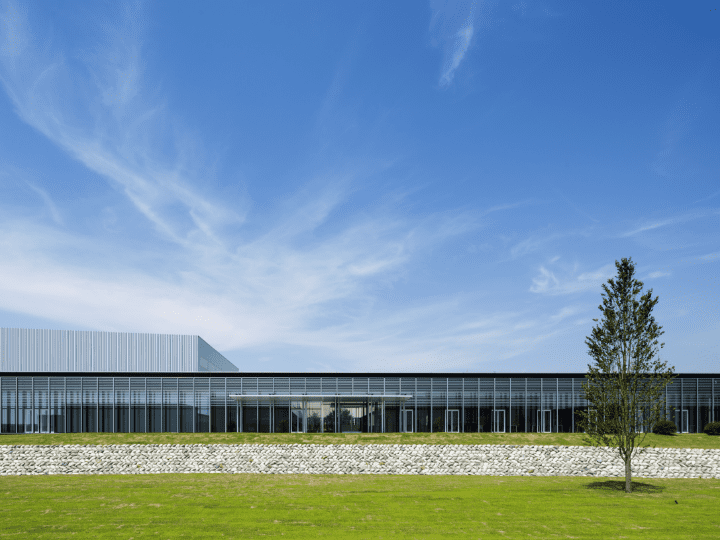
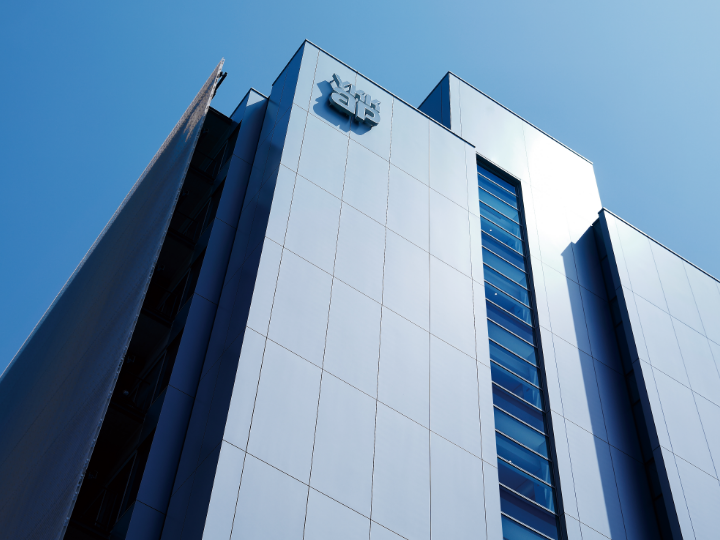
Standing approximately 27m high with a test area of approximately 1,200m2, "N-CueB" is a facility for testing the airtightness, watertightness, wind pressure resistance, seismic resistance, and other performance characteristics of CWs for high-rise buildings and skyscrapers. As such, it enables performance testing, which simulates extreme environmental events such as wind storms and major earthquakes, to be conducted under stable conditions indoors. Wind pressure resistance can be tested at static pressure (*2) of up to 12,000 pascals (equivalent to wind speed of approximately 140m per second), and watertightness can be tested at pulsation pressure (*3) of 7,000±750 pascals (wind speed of approximately 101 to 112m per second). To test inter-story displacement (*4), which is used to evaluate seismic performance, the girders are shaken along the width and depth axes to check for frame and member breakage, pane dropout, or other damage under severe conditions that simulate the shaking experienced by the upper floors of a high-rise building.
The testing floor has ample space, providing a one-stop shop for the quality inspections performed at each stage, including product inspections, installation verification, and dismantling inspections conducted before and after testing. It also allows checking at each step of the installation process, such as unpacking products, attaching installation jigs, and lifting, to be performed seamlessly at the construction site. Since the building is a "column-free space," it is possible for even heavyweight units, such as precast concrete CWs (*5), to be tested indoors using a mobile crane. Lighting with high color rendering is used to perform visual inspections under conditions closely resembling natural light, and floor heating and spot air conditioning are installed to ensure that employees and business partners can conduct testing in a comfortable environment throughout the year.
With "N-CueB" now in operation, YKK AP will be able to guarantee CW quality to higher standards, thereby contributing to the proliferation of safe and secure buildings and the development of new urban landscapes.
[Overview of the Namerikawa Plant "N-CueB" Facility]
| Facility Name | "N-CueB" Curtain Wall Testing Building | |
| Facility Structure | Semi-fireproof building with steel-frame construction | |
| Facility Size | Total floor area: 1,630㎡ (testing floor: approx. 1,200㎡) Height: Approx. 27m |
|
| Supported Test Unit Specifications |
Width: 7,500mm Height: 13,000mm (3 floors) Depth: 3,600mm Floor height: 4,500mm Weight: 40t |
|
| Supported Tests | Wind pressure resistance, watertightness, airtightness, inter-story displacement | |
| Design and Installation | Building | SATO KOGYO CO., LTD |
| Equipment | WIND ENGINEERING CENTER Co., Ltd. | |
| Construction Period | January 2024 to December 2025 | |
| Amount of Investment | Approx. 2.2 billion yen (including building and equipment) | |
*1: Vertical distance from the floor surface of one floor of a building to that of the floor above it.
*2: Constant pressure that does not fluctuate (static force)
*3: Pressure that fluctuates periodically with time
*4: The horizontal displacement that occurs between the floors of a building. The value obtained by dividing the displacement by the floor height is the inter-story displacement angle, and the higher this value is, the greater the deformation of the building.
The specified value for a general building under the Building Standards Act is 1/200 or less. This testing facility can handle up to 1/50 (in-plane static test).
*5: An installation method that shortens installation time and stabilizes the quality of the finished product by manufacturing exterior components, including concrete, at a factory in advance.
<Reference> Overview of the Namerikawa Plant
The Namerikawa Plant plays a central role in YKK AP’s domestic manufacturing of parts for commercial buildings, such as curtain walls for high-rise buildings and skyscrapers. It also produces a wide range of products, including windows, interior products and other products for residential use, exterior products, and insulating glass. Furthermore, the plant functions as a supply hub for distributing these products, both nationally and to the Hokuriku-Shinetsu region.

| Location | 3003 Sugimoto, Namerikawa City, Toyama Prefecture |
| Total Site Area | 639,227㎡ |
| Total Building Floor Area | 212,017㎡ |
| Main Products | Residential windows, insulating glass, sashes, exterior materials, and exterior architectural products Windows, doors, and curtain walls for low-rise, medium-rise, high-rise commercial buildings and skyscrapers |
| Start of Operations | April 1992 |
| Number of Employees | Approx. 1,000 |
| Head of Plant | Naoki Nosaka |
Download the full news release in PDF format.
* Please do not transcribe or convert for a different use the YKK AP website without permission.
* The news releases posted here were current at the time of their publication.